Card condition and grading explained
Published · 9 min read
How card condition is actually assessed, what PSA, BGS and CGC look at, and when paying to grade a card is worth it.
"Condition" is the word that moves the most money in card collecting, and it is also the one people argue about most. Two people look at the same card and one says Near Mint, the other Excellent: on a sought-after piece, the gap between those two opinions can be hundreds of euros.
This guide explains what is actually being looked at, how professional grading works, and (the question that matters) when it is worth paying for.
The four defects that decide everything
Every assessment, whether yours or PSA's, comes down to four things. In order of how much they weigh:
Corners. The first thing to go and the most noticeable. A perfect corner is sharp and crisp; held against the light it shows no white. Corner whitening is the single most common defect and the most punishing.
Edges. Run a fingernail along the edge: any roughness means micro-chipping. On dark-backed cards, edge whitening is glaring: which is why the back must always be checked as carefully as the front.
Surface. Scratches, clouding, fingerprints, factory print lines, and above all creases. A crease, however slight, destroys more value than any other defect: a creased card will never receive a decent grade, whatever else is true of it.
Centring. How well the artwork sits between the borders. It is the only defect that has nothing to do with how you treated the card: it happens at the factory. It is expressed as a ratio between margins, say 55/45, and past 60/40 it starts to weigh heavily.
share of value
Look at the shape rather than the numbers: the decline is not linear. Between Mint and Near Mint little is lost; between Near Mint and Excellent nearly a third disappears. That is where a demanding buyer stops being interested, and it is why that threshold is the most disputed.
The condition scale
The terms you will meet in every listing, best to worst:
- Mint (M): flawless. Sharp corners, no scratches, good centring. Rare even in freshly opened cards.
- Near Mint (NM): effectively perfect, at most one minimal flaw you have to look for. This is the market's reference standard: catalogue prices almost always mean NM.
- Excellent (EX): light wear, slight corner whitening. Still attractive, but no longer collector-grade to a demanding buyer.
- Good (GD): obvious wear but no structural damage.
- Light Played / Played (LP/PL): heavy wear, possibly small creases.
- Poor (PO): serious damage: major creases, tears, stains, writing.
Warning
The most common mistake is grading your own cards one category too high. Almost everyone does it, and almost always in good faith. The fix: look at the corners under a strong light and check the back as carefully as the front. A card kept in a binder for twenty years is rarely Near Mint.
Professional grading
Grading a card means sending it to a company that authenticates it, scores it with a number, and seals it in a rigid plastic case: the slab. From then on the card cannot be handled, and the grade on the slab is what the market prices it by.
The three companies that matter:
PSA: the most recognised, especially for Pokémon and sports. Graded 1 to 10. A PSA 10 ("Gem Mint") is the market's gold standard and commands the largest premiums. It is also the slowest and often the most expensive.
BGS (Beckett): gives four sub-grades (corners, edges, surface, centring) alongside the overall grade, making it the most transparent about why a card scored what it did. Its BGS 9.5 is highly respected, and the rare Black Label 10 (four perfect 10s) is the most coveted result in the hobby.
CGC: newer to cards, generally cheaper and faster, with a growing reputation. Well accepted for Magic by now.
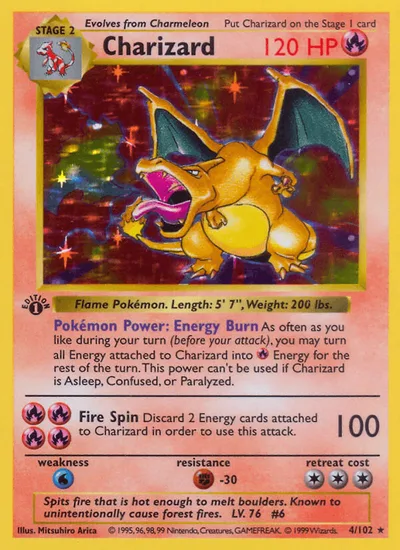
€445.32
On a card with this profile, the price gap between a raw copy and a PSA 10 can be an order of magnitude.
When grading is worth it (and when it is not)
The calculation is simple, and it almost always gives the same answer.
Grading costs between €20 and €100 per card, plus insured shipping both ways, plus weeks or months of waiting. So it only pays when the expected premium clearly exceeds that cost.
It makes sense when:
- The card is already worth at least €150-200 ungraded.
- It is in condition you have reason to believe is excellent: below a 9, the grade is often worth less than what it cost.
- It is a sought-after piece with a liquid market of graded copies to compare against.
It does not make sense when:
- The card is worth a few tens of euros. Grading costs more than the card.
- It has a crease, a damaged corner or poor centring. The grade will be low and will certify in writing that the card is mediocre.
- You need to sell quickly: turnaround is long and unpredictable.
Tip
Before shipping, check how many copies of that card are already graded highly. It is public data in the companies' population reports, and it changes everything: a card with 8,000 PSA 10s in circulation will not become rare because you add yours.
The centring problem
It deserves its own section because it surprises beginners more than anything else.
A card can be immaculate (perfect corners, spotless surface, never out of its sleeve) and still receive a mediocre grade because the artwork was printed off-centre. There is nothing you can do about it, and it is not your fault.
The practical consequence: check centring before deciding to grade, not after. It is the one of the four criteria you can verify with certainty in thirty seconds, and on its own it can make the whole exercise uneconomic.
In practice
For most collections the answer is: grade almost nothing. Assess condition honestly, record the cards as they are, and reserve grading for the few pieces that clearly clear the €150-200 threshold and that you have good reason to believe are near-perfect.
If you want to track condition card by card without grading anything, the collection tracker lets you record the condition of every copy and values it accordingly: which is 90% of the benefit, at no cost.